Poker Glossary: Terms, Slang, and Table Expressions
Clear definitions for poker betting actions, positions, board cards, strategy shorthand, tournament terms, table slang, and live-play procedure.
 Casino Context
Updated July 24, 2026
Casino Context
Updated July 24, 2026
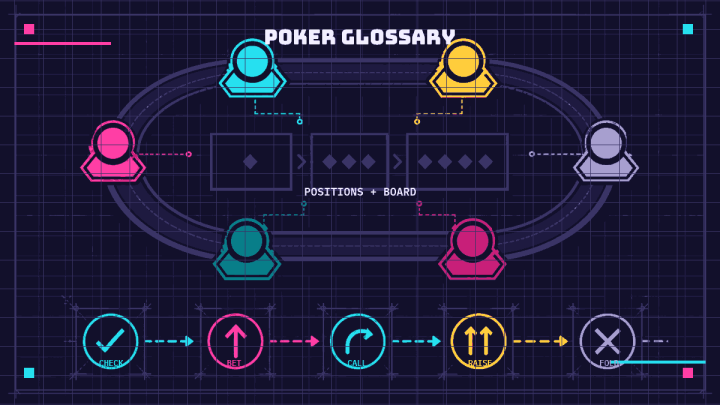
Poker language mixes formal betting actions, table positions, hand descriptions, strategy shorthand, and informal slang. A term can also change meaning between cash games, tournaments, hold’em, Omaha, and stud. Use this glossary to follow the conversation, then use the room’s current rules for any decision that affects chips.
Bottom line
At the table, clear words such as check, bet, call, raise, fold, and all-in matter more than slang. Verbal declarations can be binding under tournament and house rules.
Core betting actions
- Check
- Decline to bet while keeping the hand, possible only when no wager must be called.
- Bet
- Make the first wager in the current betting round.
- Call
- Match the current wager required to stay in the hand.
- Raise
- Increase the current wager. Minimum and maximum sizes depend on the betting structure and prior action.
- Fold
- Surrender the hand and any claim to the pot.
- All-in
- Commit all remaining chips. A player cannot be forced out of the portion of the pot their chips cover, so side pots may be created.
- Action
- The betting activity or the turn on which a player must decide.
The Poker Tournament Directors Association identifies simple, time-honored verbal declarations as official betting terms. Avoid ambiguous phrases and announce an intended raise before moving chips when the house rules call for it.
Forced bets and table positions
- Ante
- A forced contribution posted before the hand, usually by every player or through a big-blind-ante procedure.
- Small blind
- The smaller forced bet, normally immediately left of the dealer button in hold’em.
- Big blind
- The larger forced bet that sets the initial amount to call in a standard blind structure.
- Button
- The marker for the nominal dealer position. It moves around the table and determines action order.
- Under the gun (UTG)
- The first player to act before the flop in a typical full-ring hold’em hand.
- Cutoff
- The seat immediately to the right of the button.
- Position
- A player’s place in the action order. “In position” usually means acting after an opponent on later streets.
Board and hand terms
- Hole cards
- Private cards dealt to one player.
- Community cards or board
- Face-up cards shared by eligible players in games such as hold’em and Omaha.
- Flop
- The first three community cards dealt together in hold’em and Omaha.
- Turn
- The fourth community card.
- River
- The fifth and final community card.
- Kicker
- An unpaired side card used to break a tie between otherwise equal-ranked hands.
- Nuts
- The strongest possible hand given the current board and game rules.
- Draw
- An incomplete hand that can improve with specified future cards, such as a flush draw.
- Out
- An unseen card believed to improve a hand to a winner. An apparent out may be “dirty” if it can also improve an opponent more.
Betting and strategy shorthand
- Three-bet
- The third wager in a betting sequence: an opening bet, a raise, then a re-raise. Preflop, the big blind is commonly treated as the first bet.
- Continuation bet or c-bet
- A postflop bet by the player who was the aggressor on the previous street, commonly the preflop raiser.
- Value bet
- A bet intended to be called by enough weaker hands to make betting preferable to checking.
- Bluff
- A bet or raise intended primarily to make stronger hands fold.
- Semi-bluff
- A bluff made with a drawing hand that can improve if called.
- Slow play
- Play a strong hand passively to encourage later action. It is not the same as deliberately delaying the game.
- Pot odds
- The price of a call compared with the pot that can be won.
- Implied odds
- An estimate that includes additional chips that may be won on later streets.
- Equity
- A hand’s share of the pot based on its chance to win or tie against an assumed range.
- Range
- The set of hands a player may plausibly hold, rather than one guessed hand.
Common table slang
| Term | Meaning |
|---|---|
| Bad beat | A strong favorite loses after the remaining cards produce an unlikely reversal. |
| Cooler | A very strong hand loses to an even stronger hand in a situation that is difficult to avoid. |
| Donk bet | Informal term for betting into the prior street’s aggressor before that player can act. |
| Hero call | A difficult call with a relatively modest hand, usually made because a bluff is suspected. |
| Jam or shove | Move all-in. |
| Limp | Enter an unraised pot by calling the big blind rather than raising. |
| Muck | The pile of discarded cards, or the act of folding/discarding without showing when permitted. |
| Tilt | An emotional state that disrupts sound decision-making. |
Tournament and pot terms
- Bubble
- The stage immediately before the remaining players reach a payout threshold.
- Chip leader
- The player with the largest tournament stack at that time.
- Effective stack
- The maximum chips that can be won or lost between players in a hand, limited by the shorter relevant stack.
- Main pot
- The pot for which every remaining eligible player has contributed the covered amount.
- Side pot
- A separate pot created when one or more all-in players cannot match later betting.
- Heads-up
- Play between two remaining players. Blind and action order differ from a multi-player table.
- Orbit
- A complete circuit of the dealer button around the table.
Procedure and conduct terms
- Angle shooting
- Using ambiguous or unethical conduct to manipulate a ruling or opponent without straightforward play. House penalties can apply.
- String bet
- An attempted multi-motion wager that may be ruled only a call or smaller action when no raise was declared.
- Acting out of turn
- Taking an action before preceding players have acted. The action may become binding under specified conditions.
- Floor
- The poker-room official called to make or review a ruling.
- One player to a hand
- The principle that a player must make decisions without outside advice during a live hand.
Cash rooms, online sites, and tournament series can define procedures differently. When chips are at risk, pause the action and ask the dealer or floor for the applicable rule rather than arguing from slang.