What Is RTP in Casino Games?
RTP is the percentage a game is designed to return across extensive play. See how theoretical and actual RTP differ, why sessions vary, and where to find the applicable rate.
 Casino Context
Updated July 24, 2026
Casino Context
Updated July 24, 2026
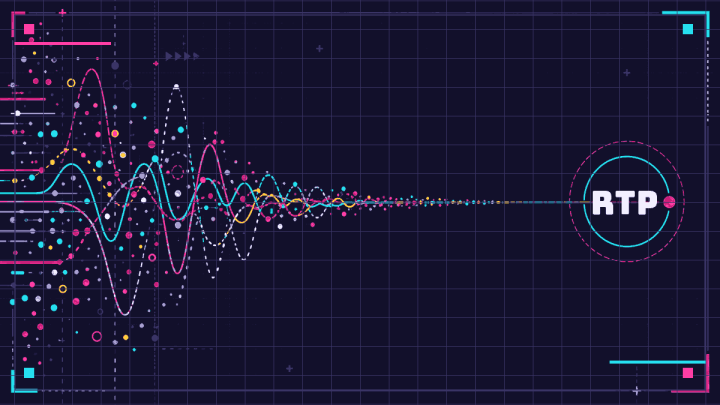
Return to player, usually shortened to RTP, is the percentage of total wagers that a game is designed to return as prizes over a very large number of plays. A 96% theoretical RTP does not mean that every player receives 96 cents back from a $1 spin. It describes the game’s long-run mathematics, not the result of one spin or one session.
RTP in one sentence
RTP is a long-run design average for a specific game and paytable; short sessions can finish far above or below it.
Theoretical RTP versus actual RTP
| Measure | What it means | Who uses it |
|---|---|---|
| Theoretical RTP | The designed percentage expected across the game’s complete mathematical model or a sufficiently large simulation. | Players compare published rules; developers, test laboratories, and regulators assess the game design. |
| Actual RTP | Total prizes awarded divided by total stakes over a measured period. | Operators and testing teams monitor whether live performance remains within an acceptable statistical range. |
Gaming Laboratories International defines percentage RTP as the expected share of wagers returned in the long run. The UK Gambling Commission describes theoretical RTP as the designed and advertised value, while actual RTP is calculated from live wins and turnover. Actual results fluctuate around the theoretical value, especially when the sample is small or the game is highly volatile.
A worked 96% RTP example
Suppose a game has a theoretical RTP of 96%. Across $1,000,000 in total stakes, its mathematical model points to about $960,000 in prizes and a $40,000 difference. That 4% difference is the corresponding theoretical house edge:
Total stakes
$1,000,000
96% theoretical return
$960,000
4% theoretical house edge
$40,000
The calculation describes aggregate play, including money that may be won and wagered again. It does not promise that a person staking $100 will finish with $96. One player might lose the full amount; another might trigger a prize worth many times the stake.
RTP does not tell you win frequency
Two slots can share a 96% RTP while feeling completely different. One may return many small prizes; another may allocate more of its mathematical return to rare bonuses or jackpots. RTP measures the expected amount returned, not how often a winning result appears.
Three separate terms matter:
- RTP
- The expected proportion of stakes returned as prizes in the long run.
- Hit frequency
- How often any defined winning result occurs. A game can count a prize smaller than the stake as a hit.
- Volatility
- How widely outcomes tend to vary. Higher-volatility games generally place more weight on larger, less frequent prizes.
Why the exact game configuration matters
A title may be certified with more than one RTP configuration. The operator or market can determine which approved version is offered. Jackpot contribution, paytable, feature rules, and bet options can also affect the published return. Never copy an RTP from a review of the same title and assume that it applies to the version on your screen.
Check the game’s help, information, or paytable screen before play. The UK Gambling Commission’s RTS 3 requires licensed remote games to make rules and likelihood information available before a customer commits to gamble. That information may use RTP, house edge, or probabilities depending on the game.
Does a demo have the same RTP?
Not every demonstration on the internet is equivalent. Under UK Gambling Commission RTS 6, a play-for-free version offered alongside a corresponding play-for-money game on the same facility must use the same rules and accurately represent winning likelihood and prize distribution. A supplier demonstration built for marketing can be different if that difference is made clear.
Sweepstakes and social casinos operate under different legal models and may describe wagers and prizes in virtual-currency terms. A game’s RTP does not establish the cash value of Gold Coins, Sweeps Coins, or any redemption. The platform rules control currency use, eligibility, playthrough, and prize redemption.
How to use RTP responsibly
- Use RTP to compare the long-run mathematics of exact game versions, not to predict a session.
- Confirm the paytable and selected bet before relying on the displayed percentage.
- Consider volatility and maximum stake alongside RTP; a small theoretical difference does not remove short-run risk.
- Do not chase losses because actual results are below the theoretical average.
- Set a fixed spending limit. RTP does not turn gambling into an investment or positive-expectation income.
RTP questions
Is higher RTP always better?
A higher RTP means a lower theoretical house edge when comparing otherwise equivalent games and configurations. It does not guarantee a better short session, and differences in volatility, rules, or stake may matter more to the experience.
Can a slot change RTP after I lose?
A properly implemented random online slot does not raise or lower the next-spin probability merely to compensate an individual player. A platform can offer an approved configuration, but the applicable rules should identify the game information before play.
How many spins are needed to reach RTP?
There is no universal session length. The required sample depends on the complete prize distribution and volatility and can be far beyond an individual’s play. RTP is useful as a mathematical disclosure, not a personal target to chase.