Five Famous Poker Bluffs and What They Demonstrate
Five documented televised bluffs - from Moneymaker-Farha to Chafak-Bardah - analyzed for hand representation, fold pressure, sizing, and strategic lessons.
 Casino Context
Updated July 24, 2026
Casino Context
Updated July 24, 2026
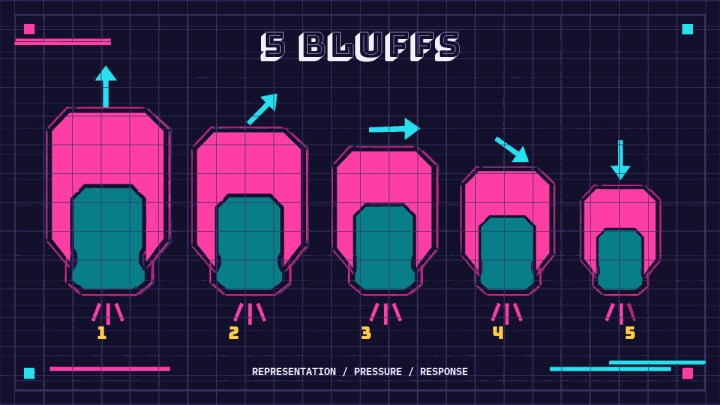
The most memorable poker bluffs combine credible hand representation, an opponent capable of folding, meaningful pressure, and a setting viewers remember. This selection is not a statistical ranking of every recorded hand. It highlights five well-documented televised bluffs that demonstrate different strategic ideas.
Selection method
Each hand had to have a documented opponent, setting, action sequence, and strategic lesson. Fame alone was not enough, and a successful bluff is not automatically a correct bluff.
1. Chris Moneymaker vs. Sam Farha, 2003 WSOP Main Event
Heads-up for the Main Event title, Moneymaker held king-seven against Farha’s queen-nine. The board ran nine-six-two-eight-three, leaving Farha with top pair and Moneymaker with king high after a missed straight draw. Moneymaker moved all-in on the river, applying tournament-ending pressure. Farha folded the winning hand.
The hand became known as the “Bluff of the Century” and is inseparable from Moneymaker’s eventual 2003 victory. Its lesson is not that an amateur should shove every missed draw. Moneymaker’s line could represent a completed straight or other strong value hand, and Farha had to risk the match with only one pair.
2. Tom Dwan vs. Barry Greenstein and Peter Eastgate, High Stakes Poker
In a deep three-way cash-game pot, Greenstein held aces, Eastgate held four-two, and Dwan held queen-ten. The flop was two-ten-two: Eastgate had three of a kind, Greenstein had an overpair, and Dwan had top pair. After Greenstein bet, Dwan raised and both opponents called.
The turn was a seven. Eastgate and Greenstein checked, and Dwan bet $104,200. Eastgate folded the best hand; Greenstein then folded his aces. The bluff is unusual because Dwan pressured two strong, differently constructed ranges at once. It relied on stack depth, opponent tendencies, and the story told by his flop raise - not simply aggression.
3. Phil Ivey vs. Paul Jackson, 2005 Monte Carlo Millions
Ivey and Jackson reached a paired jack-high flop with queen-eight and six-five respectively. Neither player had a made hand. Ivey bet, Jackson raised, and the raises continued until Jackson made another re-raise but left chips behind. Ivey moved all-in, and Jackson folded.
This was a bluff against another bluff. Ivey’s final decision used more than his cards: Jackson’s raise sizing left open the possibility of folding, and Ivey held the larger stack heads-up. The hand shows why the last aggressive action can succeed when the opponent’s range contains enough bluffs - but also why repeated re-bluffing is extremely high variance.
4. Isaac Haxton vs. Ryan Daut, 2007 PokerStars Caribbean Adventure
Haxton held three-two and Daut held seven-five on an ace-queen-four flop. Haxton check-called a bet, both players checked the king turn, and the river paired the queen. Haxton bet 700,000 with three high. Daut raised to 2 million with seven high, turning his hand into a bluff. Haxton then moved all-in for 7 million, and Daut folded.
Haxton’s river shove attacked the weakness implied by Daut’s turn check and the composition of a river raising range that could still contain bluffs. Like the Ivey-Jackson hand, it is memorable because both players were trying to win without showdown value.
5. Sara Chafak vs. Ronnie Bardah, PokerStars Shark Cage
Chafak held ace-two against Bardah’s eight-four. Bardah flopped bottom pair on queen-five-four; the turn paired the four and gave him three of a kind. Chafak continued raising through the turn and moved all-in on the river with ace high. Under the show’s time pressure, Bardah folded trips.
The hand remains debated as both a bold bluff and a painful fold. That debate is useful. A bluff’s result does not prove its long-run quality, and a fold can be understandable even when the broadcast reveals that it was wrong. The player at the table does not see both sets of hole cards.
What the five hands have in common
- 2003 · Moneymaker vs. FarhaWSOP Main Event heads-up river shove with king high.
- 2005 · Ivey vs. JacksonMonte Carlo Millions heads-up re-bluff on a paired flop.
- 2007 · Haxton vs. DautPokerStars Caribbean Adventure river shove with three high.
- High Stakes Poker · Dwan, Greenstein, EastgateA deep three-way turn bet folded trips and an overpair.
- PokerStars Shark Cage · Chafak vs. BardahRiver pressure induced a fold from trips under the show’s format.
| Hand | Primary pressure point | Main lesson |
|---|---|---|
| Moneymaker-Farha | Tournament life with one pair | A missed draw can credibly represent a completed hand. |
| Dwan-Greenstein-Eastgate | Two capped but strong ranges | A coherent multi-street story can pressure more than one opponent. |
| Ivey-Jackson | Opponent retained room to fold | Bet sizing can reveal whether maximum pressure remains effective. |
| Haxton-Daut | River raise contained bluffs | A re-bluff depends on range construction, not hand strength alone. |
| Chafak-Bardah | Unusual line and time pressure | Confusing a strong player can work, but the result invites scrutiny. |
How to judge a bluff without seeing the result
- Identify the stronger hands the bettor can credibly represent.
- Identify the missed draws and weak hands available as bluffs.
- Ask whether the opponent’s range contains enough hands that can fold.
- Compare the bet size with the pot and the required fold frequency.
- Consider stack depth, tournament payouts, and future action.
- Do not label a bluff good merely because the opponent folded.
Television makes bluffing look central because hidden cards create drama. In ordinary play, value betting, position, hand selection, bankroll control, and disciplined folding occupy far more decisions. Bluffing too often against players who rarely fold is a fast way to lose chips.