What Do Casino Dealers Wear?
Casino dealers usually wear a property-issued uniform built for recognition, professional presentation, movement, and game security. Exact styles vary.
 Casino Context
Updated July 24, 2026
Casino Context
Updated July 24, 2026
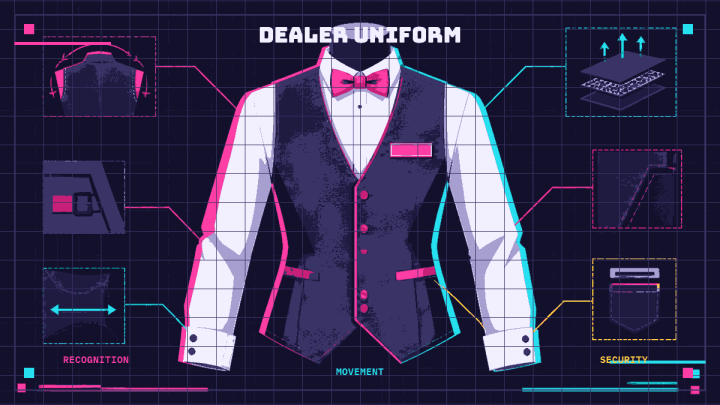
Casino dealers usually wear a property-issued uniform designed to look professional, identify them as staff, and let them handle cards, chips, dice, and equipment without obstruction. There is no universal dealer outfit. A white shirt with dark trousers or a skirt remains familiar, but modern uniforms also include branded shirts, waistcoats, jackets, dresses, aprons, and themed pieces.
The casino sets the exact standard. The game, jurisdiction, venue style, special event, and whether the dealer works on a physical or live-streamed floor can all change what appears in the uniform.
Typical casino-dealer uniform components
| Component | Common approach | Practical reason |
|---|---|---|
| Shirt or blouse | Property color, often with a logo or name badge | Identifies the dealer and creates a consistent presentation |
| Trousers, skirt, or dress | Coordinated with the venue’s uniform | Allows a consistent staff look without defining the job by gender |
| Waistcoat or jacket | Used at some formal, VIP, or themed tables | Matches the property or gaming area’s visual style |
| Apron | Required in some jurisdictions or operations; may be pocketless | Helps standardize appearance and can support game-security controls |
| Footwear | Usually closed, stable, and suitable for long shifts | Dealers may stand for much of a shift |
| Name badge or credential | Displayed according to property and licensing rules | Makes staff easy to recognize and supports accountability |
This is a component matrix, not a dress code. A dealer should follow the written policy supplied by the employer rather than assume that a traditional black-and-white outfit will be accepted.
Why casinos use assigned uniforms
A dealer is simultaneously a host, game operator, transaction handler, and visible participant in a regulated process. O*NET describes the role as operating table games, paying wins, collecting losing bets, exchanging currency for chips, inspecting equipment, and following applicable rules. Accuracy, hand use, public contact, and attention to detail are central to the job.
The uniform supports those duties in several ways:
- Recognition: players and supervisors can identify the dealer quickly.
- Consistency: dealers at the same property present a common service standard.
- Movement: sleeves, accessories, and fit should not interfere with dealing motions.
- Security: controlled garments can make unusual handling or concealed items easier to detect.
- Maintenance: a managed uniform program can keep garments consistent and ready for rotating shifts.
Current employer materials illustrate that uniforms are operational equipment, not merely formalwear. MGM’s dealer-academy benefits include uniform cleaning. Crown Resorts advertises a laundered, tailored uniform. Delaware Park requires dealers to wear the assigned uniform comfortably.
Security can affect the design
Gaming rules may specify features that are not obvious to a guest. Alberta’s casino handbook, for example, requires dealers in a gaming pit to wear a pocketless apron. It also requires each casino licensee to enforce a dress code that helps patrons recognize gaming workers and reduces the opportunity for criminal activity in gaming and cash-handling areas.
That rule is jurisdiction-specific, so it should not be presented as a worldwide standard. It demonstrates the logic behind features such as limited pockets, visible hands and cuffs, distinct employee groups, and controlled accessories. The goal is to support surveillance and game protection while the dealer handles items of value.
Do all dealers wear black and white?
No. Black and white is a recognizable casino style, especially when a property wants a formal look, but it is not the definition of a dealer uniform. Brand colors, patterned shirts, colored waistcoats, seasonal garments, and game-specific costumes can all appear.
A clean and professional appearance is a more reliable constant than any color combination. Marriott’s current casino-dealer description requires the uniform and personal appearance to be clean and professional. Other employers phrase the requirement as compliance with appearance, grooming, or uniform guidelines.
Uniform standards should not be gender assumptions
Older descriptions often divide the uniform into “male dealer” and “female dealer” rules, then assume trousers for one group and skirts or cocktail dresses for the other. That approach is neither necessary nor reliably current.
A modern explanation should focus on the approved garment options for the role. Properties may offer different cuts or coordinated pieces, but the functional standard is the same: the uniform should fit, remain presentable, permit the required movements, and comply with company policy. Religious dress, disability-related needs, pregnancy, and other protected or practical requirements may also call for an accommodation under the law and the employer’s process.
Hair, jewelry, tattoos, and grooming
These details vary substantially by employer. A property may set rules for hair, facial hair, nails, jewelry, fragrance, visible tattoos, piercings, and cosmetics. It may also relax or revise those rules over time. There is no evidence-based reason to claim that tattoos or piercings are always allowed or always prohibited across casinos.
The consistent workplace requirement is that personal presentation must not interfere with hygiene, identification, safe movement, game protection, or the assigned uniform. Current job listings commonly use broad language such as “clean and professional” or “professional grooming standards,” leaving the exact policy to the employer.
What do live-casino dealers wear?
Live-casino studios also use coordinated uniforms, but the visual priorities differ. The camera frames the dealer, table, cards, and game interface, so the uniform may be selected for brand contrast, lighting, and on-screen clarity. Branded jackets, dresses, shirts, or waistcoats are common visual choices, while footwear may never appear in the normal shot.
The essential duties remain similar: present the game, handle equipment accurately, communicate with players, and follow game procedures. A live studio’s outfit can therefore be more theatrical without making its security and dealing standards less important.
What should a new dealer wear to training or an audition?
Use the instructions from the casino or dealer school. A trainee uniform may differ from the live-floor uniform, and an audition may require business attire rather than issued garments. If the invitation does not say, ask the recruiter before the date.
Do not guess based on movies. Arrive in clean, movement-friendly clothing and shoes that meet the supplied standard; keep accessories restrained; and be prepared to demonstrate chip handling, game procedures, mental arithmetic, communication, and accuracy. Those skills are more central to the role than reproducing a stereotypical tuxedo look.