Five Craps Tips for Learning the Table
Learn the Pass Line cycle, odds bets, working status, wager families, and total exposure before navigating the rest of a craps layout.
 Casino Context
Updated July 24, 2026
Casino Context
Updated July 24, 2026
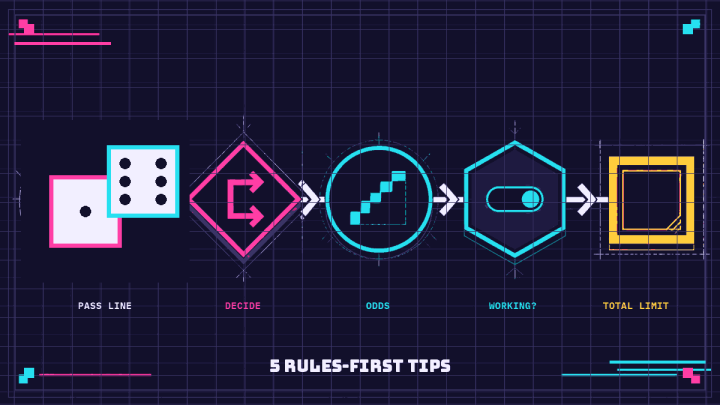
Craps looks complicated because one table holds many different wagers. The game becomes easier when you learn one sequence at a time. Start with the come-out roll and point cycle, understand what each chip covers, and ignore the center-table proposition bets until you can state their odds and payouts.
Bottom line
Learn the Pass Line sequence first, confirm when bets are working, use only wagers you can explain, and never increase the stake to chase a dice result.
1. Learn the Pass Line cycle
A conventional Pass Line bet begins on the come-out roll. A total of 7 or 11 wins; 2, 3, or 12 loses. A total of 4, 5, 6, 8, 9, or 10 establishes that number as the point. The shooter then continues until the point repeats, which wins the Pass Line bet, or a 7 appears, which loses it.
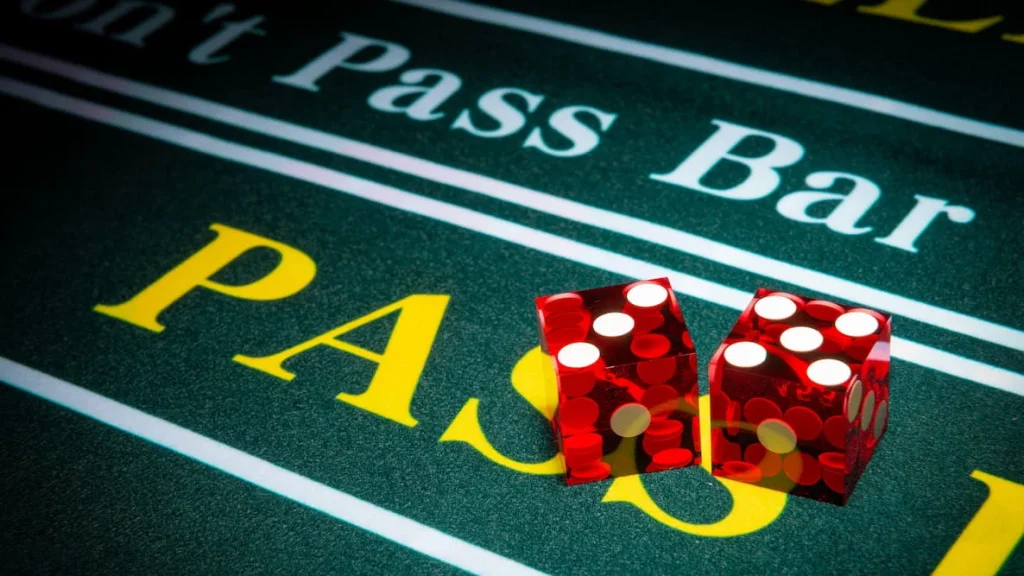
- Come-out rollThe first roll starts a new Pass Line sequence.
- Natural or craps7 or 11 wins; 2, 3, or 12 loses.
- Point established4, 5, 6, 8, 9, or 10 becomes the target.
- Point or sevenThe sequence ends when the point repeats or a 7 is rolled.
Do not place a Pass Line chip after a point is already established unless you understand the effect. At many tables the wager remains allowed but no longer has the come-out-roll part of the sequence.
2. Separate the base bet from the odds bet
After a point is established, a conventional table may allow an additional Pass Line “odds” wager behind the base chip. The odds portion pays according to the point’s true dice odds: 2 to 1 on 4 or 10, 3 to 2 on 5 or 9, and 6 to 5 on 6 or 8. The casino limits how large the added wager can be.
The base Pass Line bet and odds bet are settled together but are mathematically distinct. Check the posted maximum and the correct chip multiple before placing odds. Variants can use different rules, and some online games combine controls in a way that makes the two amounts easy to confuse.
3. Know whether a wager is working
Some bets are turned off by default on a come-out roll; others remain active. Dealers may mark or announce the state, and a player may be allowed to call a bet on or off before the roll. Never assume a place, come, lay, or odds wager is active merely because the chips remain on the layout.
Confirm the table procedure for:
- place bets during a come-out roll;
- Come and Don’t Come odds after a number travels;
- hardways and other multi-roll wagers;
- removing or reducing a wager before the next roll; and
- online controls labeled working, off, take down, or repeat.
4. Treat every box as a separate wager
A craps layout is a menu, not one combined bet. Pass Line, Don’t Pass, Come, Don’t Come, place, buy, lay, field, hardways, and one-roll propositions have different win conditions and paytables. Similar-looking payouts can also handle commission differently.
Base wagers that begin with the come-out roll and may continue through a point cycle.
Wagers tied to the box numbers 4, 5, 6, 8, 9, and 10.
New Pass-like or Don’t-Pass-like sequences after a point already exists.
A grouped one-roll wager whose covered totals and special payouts must be checked.
Specific one-roll or multi-roll outcomes with their own prices and typically higher house edges.
An additional wager made after a point, settled separately from the base line bet.
| Wager | Core idea | Key rule to verify |
|---|---|---|
| Pass Line | Point before 7 after the come-out stage. | Whether a late bet is accepted. |
| Don’t Pass | Generally the opposite point result. | How 12 is treated on the come-out roll. |
| Come | A Pass-like sequence beginning after a point exists. | How the chip moves and when odds can be added. |
| Place | A selected number before 7. | Payout, working status, and removal rules. |
| Field | A one-roll set of totals. | Which totals qualify and special payouts for 2 or 12. |
| Proposition | A specific one-roll or multi-roll result. | Exact combinations, payout, and whether a commission applies. |
5. Use a fixed exposure plan
Set the maximum total amount on the layout, not only the size of the first chip. A $10 Pass Line bet plus $20 odds and three $10 proposition bets places $60 at risk across different settlement conditions. Multiple bets can win or lose on the same roll.
Choose a loss limit and session time before starting. Do not press, regress, or double a wager unless the change was part of the original plan and remains inside the same total limit. Dice do not become due after a streak.
Table procedure and etiquette
- Wait for the dealer to finish payouts before reaching into the layout.
- Place chips where the dealer can identify the intended wager.
- Keep the dice over the table and follow the table’s throwing procedure.
- State any on, off, take-down, or odds instruction clearly before the roll.
- Ask the dealer to explain placement, but verify payout details on the posted rules.
- Do not blame the shooter or other players for a random result.