Is Card Counting Illegal?
Mental counting, prohibited devices, casino exclusion, and cheating are different legal questions. The answer depends on the jurisdiction and the conduct.
 Casino Context
Updated July 24, 2026
Casino Context
Updated July 24, 2026
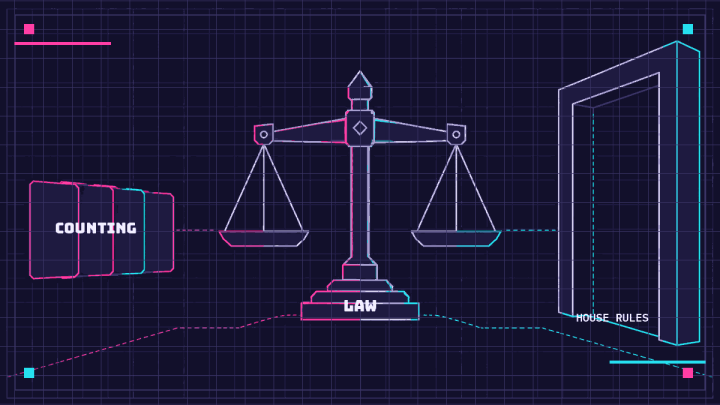
Mentally tracking cards that have already been dealt is not automatically the crime of cheating, but there is no single worldwide rule. The legal answer depends on the jurisdiction, the method used, and the casino’s rights under local law. A casino may also stop a person from playing or require them to leave even when no criminal offense has occurred.
Bottom line
Mental counting, prohibited devices, collusion, marking cards, and ignoring an exclusion order are different legal questions. Check current local law and follow any instruction to stop playing or leave.
What card counting is
Card counting estimates how the composition of an incompletely dealt blackjack shoe has changed. A player assigns values to exposed cards, maintains a running count, and may adjust for the estimated number of decks remaining. The count does not identify the next card and does not guarantee a winning hand.
Counting is relevant only when earlier cards are not immediately returned to the possible outcomes. A continuously reshuffled or freshly generated online game may not preserve a usable shoe composition between hands.
| Exposed card | Hi-Lo value | Running count |
|---|---|---|
| 5 | +1 | +1 |
| King | −1 | 0 |
| 3 | +1 | +1 |
| 8 | 0 | +1 |
| Ace | −1 | 0 |
| 6 | +1 | +1 |
The example shows arithmetic only. A running count of +1 neither identifies the next card nor establishes an advantage; deck estimation, rules, penetration, strategy, and lawful table conditions all matter.
Mental play and cheating are not the same act
Using observation and memory does not physically alter a card, interfere with equipment, misrepresent a result, or secretly obtain a dealer’s hole card. Those distinctions matter. Nevada’s current gaming-crime statutes separately define cheating and prohibit specified fraudulent acts.
The 1982 New Jersey Supreme Court decision in Uston v. Resorts International Hotel addressed a casino’s authority to exclude a card counter under that state’s regulatory system. The court found that the casino could not exclude Uston for counting under the rules then in force without action by the state commission. That decision is specific to New Jersey law and its facts; it is not a nationwide license to count cards.
Devices can change the legal answer
Nevada Revised Statutes section 465.075 prohibits using or possessing with intent to use specified devices, software, or hardware designed to obtain an advantage in a licensed game. The statutory examples include equipment that keeps track of cards played or analyzes strategy. A phone, hidden computer, camera system, or remote assistant can therefore create a very different legal issue from mental arithmetic.
Other jurisdictions define cheating and prohibited equipment differently. The UK Gambling Act 2005, for example, creates a cheating offense without turning this guide into a substitute for a fact-specific legal interpretation. Do not bring or use assistance technology at a table based on a general claim that “card counting is legal.”
| Activity | Why the distinction matters |
|---|---|
| Mental counting | Uses observed public information and memory; local exclusion rules can still apply. |
| Electronic or mechanical assistance | May fall within an express device prohibition. |
| Marking or switching cards | Changes or manipulates game equipment and can constitute cheating. |
| Seeing a dealer card accidentally | Facts and local rules matter; using a device or collusion to obtain it is different. |
| Returning after a formal exclusion | Can create a trespass or other offense separate from the playing strategy. |
What a casino can do
Depending on local law, a casino may change shuffle procedures, restrict the allowed bet spread, limit the player to flat betting, refuse further blackjack play, or ask the player to leave. Regulatory rules and public-accommodation law determine how far an operator’s exclusion authority extends.
Do not argue at the table or try to evade an instruction. Ask whether play is ending only for blackjack or for the entire property, request any written notice, cash out through the procedure provided, and leave if directed. If chips, funds, identity documents, or personal property are disputed, preserve records and contact the relevant gaming regulator or a qualified local lawyer.
Card counting is not a guaranteed income method
Even when lawfully performed, accurate counting requires correct basic strategy, reliable conversion of the count, suitable rules, sufficient deck penetration, and disciplined bet sizing. Errors, variance, table limits, and operator countermeasures can eliminate an estimated advantage. A positive mathematical expectation over many hands does not prevent a large short-term loss.
Before playing
- Check the current law and regulator guidance for the place where the table is located.
- Do not use a phone, app, wearable, remote assistant, or other device to track or analyze live play.
- Never mark, bend, conceal, switch, or obtain unauthorized information about cards.
- Follow table rules and any lawful instruction to stop playing or leave.
- Do not treat a general article as legal advice for a real dispute or prosecution.