Five Baccarat Tips Based on the Actual Rules
Learn baccarat scoring, compare Player and Banker terms, evaluate Tie and side bets separately, ignore scoreboard myths, and control total exposure.
 Casino Context
Updated July 24, 2026
Casino Context
Updated July 24, 2026
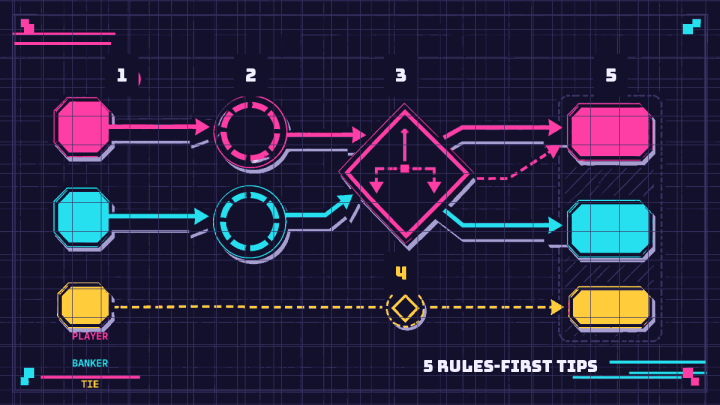
Punto banco baccarat has a small set of main bets and fixed drawing rules. The player normally chooses Player, Banker, or Tie; the table then deals and draws according to the rules. A sound approach is to understand the scoring, compare the main-bet paytable, ignore pattern claims, and keep the total stake fixed.
Bottom line
Learn the automatic draw procedure, compare Player and Banker terms, treat Tie and side bets separately, ignore scoreboards as predictors, and set limits before play.
1. Learn the point total
Aces count as 1, cards 2-9 count at face value, and 10s and face cards count as zero. Only the last digit of the total matters. A 7 and 8 therefore total 5, not 15. The hand closer to 9 wins.
Each hand starts with two cards. A two-card total of 8 or 9 is a natural and usually ends the draw. Otherwise, fixed rules decide whether the Player hand draws a third card and whether the Banker hand draws based partly on the Player’s third card. The bettor does not choose hit or stand.
2. Compare Player and Banker terms
Under a common commission game, a winning Player bet pays even money while a winning Banker bet pays even money less a commission. The Banker hand’s drawing rules give it a slightly higher probability of winning, which is why the commission exists. Ties push both main bets under standard rules.
No-commission variants can change the payout for a particular Banker total instead of charging the standard commission. Read the actual paytable; “commission free” does not mean the wager has no house advantage.
| Bet | Hand outcome probability | Common house edge | What to verify |
|---|---|---|---|
| Player | 44.6247% | About 1.24% | Standard 1-to-1 payout and tie treatment. |
| Banker | 45.8597% | About 1.06% | Standard 5% commission or an alternate payout rule. |
| Tie | 9.5156% | About 14.36% at 8 to 1 | Displayed payout and whether main bets push. |
The bars and table use the conventional eight-deck drawing rules, a 5% commission on winning Banker bets, and an 8-to-1 Tie payout. They are a reference case, not a substitute for the active table’s rules.
3. Evaluate Tie and side bets on their own
The Tie bet is not a hedge that completes the Player/Banker choice. It is a separate wager with a larger payout and a lower hit probability. Pair, suited, total, margin, and bonus bets likewise have their own rules and mathematical return.
Do not judge a side bet only by its headline payout. Identify every qualifying outcome, the probability information provided, and whether the stake is returned in any push condition. If those details are unavailable or unclear, skip it.
4. Do not use the scoreboard as a forecast
Baccarat roads record earlier Player, Banker, and Tie results in different visual formats. They can help a player audit the announced history. They do not cause the next hand and do not turn a streak, chop, or pattern into a predictive signal.
Betting Banker after a run of Banker results and betting Player because Banker seems “due to lose” are opposite stories applied to the same independent next deal. Neither changes the cards or drawing rules.
5. Keep stake and session limits fixed
Martingale and cancellation systems increase or rearrange stakes after results. They cannot alter the next hand’s probability. A progression can collide with table maximums or exhaust the budget during a normal losing sequence.
- Set the loss limitUse only a predetermined entertainment amount.
- Choose the base stakeKeep it small enough for the planned number of hands.
- Choose eligible wagersDecide in advance whether side bets are excluded.
- Track total stakedDo not treat returned winnings as cost-free play.
- Stop on timeEnd the session at the money or time limit.
Common baccarat mistakes
- Trying to choose whether the Player or Banker hand draws.
- Confusing the hand named Player with the person placing the wager.
- Ignoring commission or a no-commission payout exception.
- Assuming Tie and side bets have the same return as the main bets.
- Following a road pattern as if it predicts the next deal.
- Increasing the stake to recover an earlier loss.
Sources
- New Zealand Department of Internal Affairs: Baccarat Game Rules, Division 5
- Nevada Gaming Control Board: approved baccarat games and rules of play
- British Columbia government: BCLC high-limit baccarat evaluation and main-wager house advantage
- UK Gambling Commission: RTS 3, rules and likelihood information
- UK Gambling Commission: RTS 7, generation of random outcomes