Online Scratch Card Strategy: What You Can and Cannot Control
Reveal patterns cannot improve a predetermined or random instant-win result. Learn how to read prize odds, compare games, and control the amount at risk.
 Casino Context
Updated July 24, 2026
Casino Context
Updated July 24, 2026
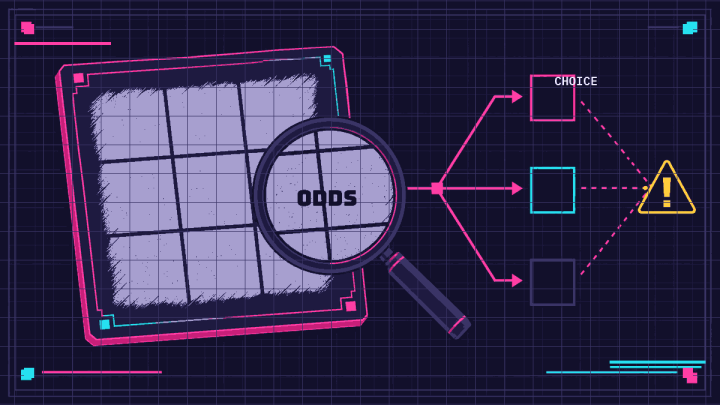
Online scratch cards and instant-win games are games of chance. Scratching, tapping, choosing a panel, or revealing symbols in a particular order does not create a winning result. In many online instant games, the result is determined when the play is purchased; the animation reveals that result rather than changing it.
Bottom line
No reveal pattern improves the odds. The useful decisions are whether to play, which published odds and price to accept, how much to spend, and when to stop.
How online instant-win results work
The exact process depends on the operator and jurisdiction. The Irish National Lottery states that an online Instant Win Game outcome is set at purchase after being randomly selected from the possible outcomes. The UK National Lottery’s rules likewise separate the purchased play and its game procedures from the visual interaction used to reveal it.
That means choosing the left card first, waiting before a click, closing and reopening the game, or using an “auto reveal” control does not turn a losing purchased play into a winner. In other implementations, an RNG may determine results during the game cycle, but regulated random outcomes must still follow the published rules and cannot be predicted through a reveal ritual.
Overall odds are not the odds of profit
“Overall odds of winning 1 in 3” means each eligible play has the stated chance of returning any prize under that game’s rules. It does not mean every third purchase wins, and it does not say that the prize will exceed the ticket price. Some counted prizes may equal or be less than the amount spent.
Check at least four figures before playing:
- Price per play: the amount placed at risk each time.
- Overall prize odds: the chance of any prize, including small awards.
- Top-prize odds: normally much longer than the overall odds.
- Prize table or RTP: the distribution of awards or long-run return, when published.
Two games can advertise the same overall odds while distributing prizes very differently. One may include many break-even awards and a remote top prize; another may have a different mix. A large headline jackpot does not establish a better expected return.
Why common scratch-card systems fail
| Claim | What the rules support |
|---|---|
| “Buy three when the odds are 1 in 3.” | Each play can still lose. An average frequency is not a three-ticket guarantee. |
| “Reveal likely prize spots first.” | The reveal order does not change a result that has already been determined. |
| “A losing streak means the next one is due.” | Independent plays do not become more likely to win because previous plays lost. |
| “More expensive games have better value.” | Price and maximum prize alone do not establish overall odds or expected return. |
| “A demo shows how often the paid game wins.” | A demo teaches controls. Treat it as evidence of paid-game odds only when the rules and probabilities are explicitly the same. |
A cost-control strategy
A plan cannot improve the mathematical return, but it can limit the amount exposed. Suppose the session budget is $20. A $1 game allows at most 20 purchases if no prize is replayed; a $5 game allows four. Counting returned prizes as “house money” hides the total amount repeatedly put at risk, so track purchases and withdrawals separately.
- Choose the loss limitUse only money set aside for entertainment, not bills or savings.
- Read the game rulesVerify eligibility, price, odds, prize table, expiry, and claim process.
- Set a purchase countDivide the limit by the price and do not add more after a loss.
- Record the resultTrack total spent and total returned rather than only the latest prize.
- Stop at the limitDo not extend the session because a win feels due.
How to compare two games
Use the current game-specific rules, not a generic lobby label. Compare the cost of one play, chance of any prize, chance of the top prize, number and value of prizes, and whether prizes are cash, credits, or another entry. If RTP is published, remember that it is a long-run theoretical figure rather than a personal-session forecast.
Also confirm location, age, account, and claim requirements. A game offered by a lawful lottery in one country may not be available or payable elsewhere. Promotional free plays can have separate eligibility and expiry conditions.
When to skip a game
- The operator does not publish game-specific rules or prize odds.
- The price or prize unit is unclear.
- A promotion obscures the spend required to receive a play.
- The game is unlawful or unavailable in your location.
- You are trying to recover a previous loss or spending beyond the preset limit.
- The play is no longer entertainment or is causing stress, secrecy, or conflict.