How Many Casinos Are in Las Vegas?
The answer depends on geography and licensing. In May 2026, 80 nonrestricted licensees reported across the Strip and downtown statistical markets.
 Casino Context
Updated July 24, 2026
Casino Context
Updated July 24, 2026
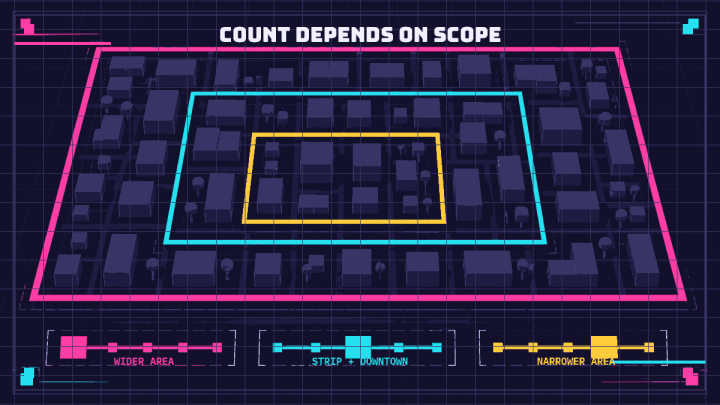
There is no single official number of “casinos in Las Vegas” because the answer changes with the boundary and definition. The clearest current benchmark is the Nevada Gaming Control Board’s May 2026 revenue report: 58 nonrestricted gaming licensees reported in the Las Vegas Strip area and 22 in the Downtown Las Vegas area, for 80 across those two tourism markets.
That is not the same as saying there are exactly 80 casino resorts in the City of Las Vegas. Most of the Strip is outside the city, some nonrestricted licensees are not large resorts, and hundreds of smaller restricted gaming locations across Clark County are bars, restaurants, grocery stores, and similar businesses rather than casinos in the everyday sense.
Current count by useful definition
| Definition | May 2026 benchmark | What it means |
|---|---|---|
| Las Vegas Strip area | 58 reporting nonrestricted licensees | The Gaming Control Board’s Strip statistical market, not the City of Las Vegas |
| Downtown Las Vegas area | 22 reporting nonrestricted licensees | The Board’s downtown statistical market |
| Strip plus downtown | 80 reporting nonrestricted licensees | A practical visitor-market benchmark |
| All Clark County | 216 reporting nonrestricted licensees | Includes Las Vegas-area markets plus Laughlin, Mesquite, Boulder-area properties, and other county locations |
The report was issued June 23, 2026, for gaming activity in May. Counts can change with openings, closures, ownership transitions, temporary shutdowns, and reporting adjustments.
Why the Las Vegas Strip is not the City of Las Vegas
The biggest source of confusion is geography. Clark County has jurisdiction over the world-famous Strip. The county explains that Sahara Avenue is the municipal boundary on this part of Las Vegas Boulevard; the major resort corridor south of that line is in unincorporated Clark County.
Addresses can still say “Las Vegas, Nevada” even when a property is outside the incorporated city. A strict city-limit count therefore excludes many resorts that almost every visitor considers part of Las Vegas. Conversely, a Clark County total includes distant markets that a visitor would not describe as the Las Vegas casino district.
What counts as a casino?
Nevada licensing provides a useful dividing line:
- Nonrestricted gaming license: covers establishments with table games, 16 or more slot machines, or games and slots together.
- Restricted gaming license: permits no more than 15 slot machines and no other game, with gaming incidental to the primary business.
A restricted location may be a bar, restaurant, convenience store, grocery store, drugstore, or liquor store. It is a real licensed gaming location, but counting every such business as a “casino” would produce a number that does not answer what most readers mean.
Nonrestricted is a better filter, but it is still broader than “large casino resort.” A smaller locals property, gaming hall, card room, sportsbook-related operation, or another qualifying license can fall on the nonrestricted side. The regulatory count is therefore transparent and reproducible, not a perfect list of resort hotels.
How the Gaming Control Board count works
The monthly revenue report summarizes forms filed by nonrestricted gaming licensees. It publishes one-month, three-month, and twelve-month views. The one-month “Number of Reporting Licensees” is the most current snapshot, while the longer periods can include a location that reported during part of the period but was not active in the latest month.
For May 2026, the report shows:
- 58 Strip-area reporting licensees for the month, 59 over three months, and 60 over twelve months;
- 22 downtown reporting licensees for the month, 24 over three months, and 25 over twelve months;
- 216 Clark County reporting licensees for the month, 219 over three months, and 224 over twelve months.
Using the one-month column avoids presenting a location that only reported earlier in the year as necessarily current. It also explains why another source using an annual window can publish a larger total without either source being arithmetically wrong.
Why casino lists disagree
| Choice | How it changes the total |
|---|---|
| City limits only | Excludes most Strip resorts |
| Strip only | Excludes downtown and off-Strip locals properties |
| Strip plus downtown | Captures the two main visitor markets but not every valley casino |
| All Clark County | Adds Henderson-area, Laughlin, Mesquite, Boulder-area, and other locations |
| All gaming licenses | Adds small restricted slot locations that are not primarily casinos |
| Resorts only | Requires a subjective threshold for rooms, amenities, or gaming size |
Lists can also count a combined resort complex as one destination or several licensed operations. A rebrand may change the public name without creating a new physical property, while an ownership change can affect reporting history.
So what number should visitors use?
Use 80 as a dated regulatory benchmark for nonrestricted reporting licensees across the Strip and downtown markets in May 2026. Use 216 only when discussing all nonrestricted reporting licensees across Clark County.
Neither number should be displayed as an eternal casino count. For trip planning, the useful list is smaller: properties with the games, location, opening hours, accessibility, and amenities a visitor actually wants. For research, cite the Gaming Control Board report month and define the market before comparing totals.
How to verify the latest number
The Nevada Gaming Control Board publishes a new Monthly Revenue Report and offers current location reports through its statistics portal. To update this guide, use the latest complete month, read the one-month reporting-licensee count for the Strip and Downtown Las Vegas area pages, and keep the publication date with the result.
Do not add restricted and nonrestricted counts together without labeling them. The result would mix full gaming operations with businesses where a small bank of slots is incidental to the main activity.